
How to Verify Military Memoirs: A Step-by-Step Guide
Table of Contents
- Why Verifying Military Memoirs Matters
- How to Verify Military Service Records
- Are Military Memoirs Primary Sources?
- How to Fact-Check a Memoir Claim by Claim
- Common Mistakes When Verifying Military Memoirs
- When Records and Memoirs Conflict: Weighing the Evidence
- Conclusion: A Repeatable Verification Workflow
- Frequently Asked Questions
Last Updated: October 7, 2026
Why Verifying Military Memoirs Matters
A military memoir can be a powerful window into wartime experience, but not every published account holds up under scrutiny, which is why readers need a reliable way to verify military memoirs. Learning how to verify military memoirs is the difference between reading history and reading a good story that drifts from the record.
Readers trust memoirs because they promise firsthand truth. That trust is worth protecting. When a soldier's story checks out against records, it carries weight that no novel can match.
Here is the core problem: memory fades, and publishers rarely fact-check a personal narrative before printing it. So the work falls to you, the reader.
Below, we walk through a repeatable process for checking a memoir's claims. We cover service records, primary sources, and what to do when accounts disagree.
How to Verify Military Service Records
Start with the paper trail. A service record confirms the basics: name, rank, unit, and dates of service. Without it, you are only guessing whether the author was where they say they were. The unique angle here is that most guides stop at "request the records", this section shows you which records exist, what each one actually proves, and how to read them.
Requesting Records Through the National Archives
Most veterans' records sit with the National Archives and Records Administration (NARA), specifically the National Personnel Records Center (NPRC) in St. Louis. You can request them through the National Archives military personnel records portal.
Two request paths matter:
- Standard Form 180 (SF-180), the paper request form, still accepted and often the right choice for older records.
- The online eVetRecs system, faster for recent service, but it requires the veteran's signature or proof of death for next-of-kin requests.
You will need the veteran's full name, service number (or Social Security number for later service), branch, and approximate dates of service. Expect a wait measured in weeks to months, and expect partial files. A 1973 fire at the NPRC destroyed roughly 16-18 million Army and Air Force records, so gaps are common and are not proof of dishonesty.
Which Record Actually Answers Your Question
Different records prove different claims. Match the record to the claim:
- DD Form 214 (Certificate of Release or Discharge from Active Duty), the single most useful document. It lists branch, rank at discharge, dates of entry and separation, military occupational specialty, awards, and last duty assignment. If a memoir claims a rank or award, this is the first place to check.
- Official Military Personnel File (OMPF), the full personnel file, including enlistment contracts, transfer orders, disciplinary actions, and evaluation reports. This is what SF-180 usually retrieves.
- Morning reports, daily unit strength reports that list who was present, absent, wounded, or transferred. These are the gold standard for placing a specific person in a specific unit on a specific date, and they are held at the National Archives in College Park, Maryland.
- Unit rosters and after-action reports, confirm unit-level movements and engagements, even when an individual is not named.
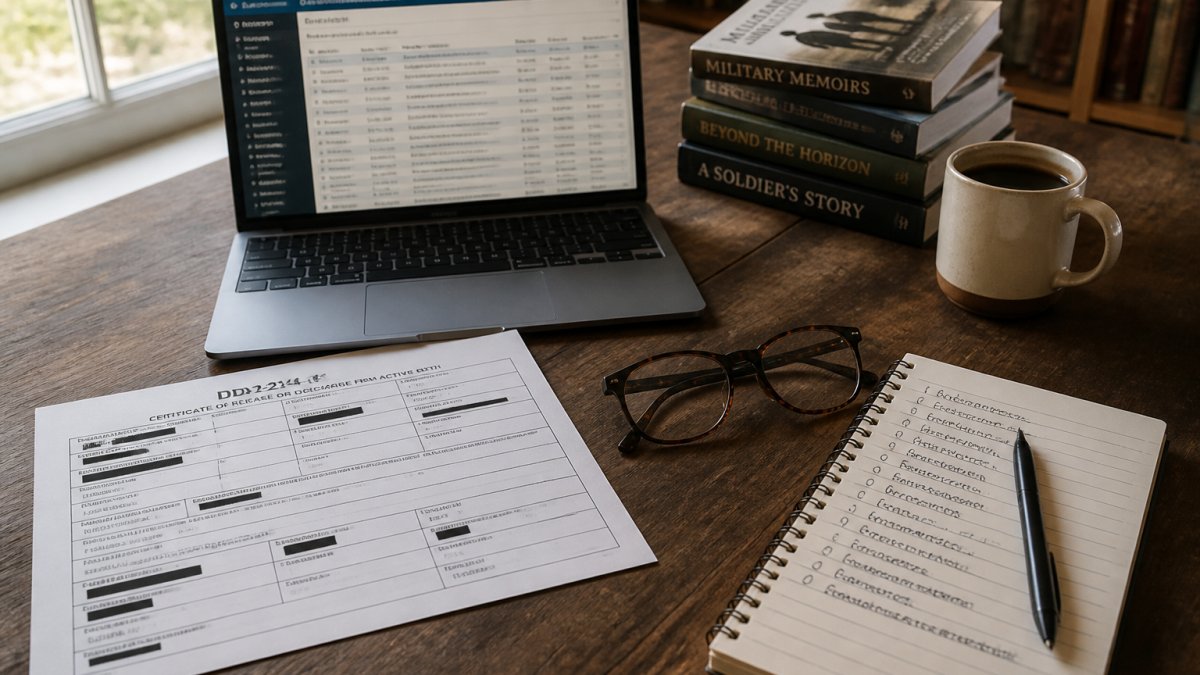
What to Look for in a Service Record
Focus on the details that anchor a story:
- Unit assignments and transfer dates
- Rank at each stage of service
- Deployments and locations
- Awards and citations, which often include a written narrative
- Dates of entry and discharge
Cross-check each against what the memoir claims. Small mismatches are normal, a memoirist may recall a transfer as happening in spring when the orders are dated April. Big ones need explaining: a claimed rank two grades above the record, or a deployment to a theater the unit never entered, are the kinds of discrepancies that warrant scrutiny.
When Records Are Incomplete
A missing file is not a verdict. Common reasons for gaps include the 1973 fire, records still held by the service branch rather than NARA, and privacy restrictions on records of veterans who separated recently. When a file is thin, fall back to morning reports, unit histories, and contemporaneous news coverage, the same sources you would use for any other claim.
Are Military Memoirs Primary Sources?
A military memoir is a primary source, meaning it comes from a participant rather than a later historian. That makes it valuable, but primary does not mean error-free. A memoir is a primary source filtered through memory and time.
For a deeper look at how historians classify these accounts, see the Library of Congress guide to primary sources.
Memoirs vs. Diaries and Official Histories
These three source types serve different purposes:
| Source Type | Written When | Strength | Weakness |
|---|---|---|---|
| Diary | During the event | Fresh, unfiltered | Fragmentary, no big picture |
| Memoir | Years later | Reflective, complete | Memory errors, bias |
| Official history | After research | Verified, sourced | Impersonal, slow to publish |
A diary captures the moment. A memoir captures the meaning. An official history captures the record. Use all three together.
How to Fact-Check a Memoir Claim by Claim
Treat each claim as its own question. Break the book into checkable statements: dates, places, units, battles, and named people. Then test each one against an independent source.
Cross-Checking with Unit Histories and Contemporary Accounts
Unit histories and after-action reports are your best allies. They record where a unit was and what it did. If a memoir places the author at a battle his unit never reached, that is a red flag worth noting.
Newspapers from the period add another layer. So do letters and interviews archived by the Veterans History Project at the Library of Congress.
Common Mistakes When Verifying Military Memoirs
The biggest mistake is treating a memoir as either fully true or fully false. Most sit somewhere in between. Memory errors and retrospective bias shape even honest accounts.
Other frequent errors:
- Assuming a records gap means the author lied
- Ignoring the difference between a memoir and a diary
- Trusting a single source instead of corroborating
- Forgetting that a self-serving account can still be accurate on facts
When Records and Memoirs Conflict: Weighing the Evidence
Conflicts are normal, and they are where careful readers earn their keep. The gap most guides leave open is what to do with a conflict once you find it. This section gives you a classification scheme and a documentation habit so that uncertainty becomes a finding rather than a dead end.
Classify the Discrepancy Before You Judge It
Not all conflicts are equal. Sort them into four buckets:
- Clerical, a date off by days, a misspelled place name, a rank recorded at a different point in the service cycle. These are usually transcription or memory artifacts, not credibility problems.
- Substantive factual, a claimed unit, deployment, award, or engagement that the record contradicts. These require a third source before you draw a conclusion.
- Interpretive, the memoirist's reading of why an operation happened, who was at fault, or what a battle meant. Records rarely settle these, and they are not the same as factual errors.
- Recollection, sensory and emotional detail (weather, sounds, the face of a comrade) that no record will confirm or deny. Treat these as outside the verification frame.
Most published disputes about memoirs collapse once you separate bucket 2 from buckets 3 and 4.
Weigh the Source, Not Just the Claim
Ask three questions of every source in the conflict:
- Proximity, which source was written closer to the event? A morning report filed the same day usually beats a memoir written forty years later on dates and unit locations.
- Purpose, which source had a reason to shade the truth? A citation written to justify an award, a memoir written to settle an old score, and an official history written to protect an institution all carry different pressures.
- Independence, does a third source break the tie? A contemporaneous newspaper dispatch, a letter home, or a photograph with a dated caption can resolve conflicts that two sources alone cannot.
Document the Uncertainty
When you cannot resolve a conflict, record it. A short entry noting the claim, the conflicting sources, and the reason you could not settle it is more useful than a forced verdict. Historians do this routinely; readers can too.
A Worked Pattern
A common pattern: a memoir places the author at a specific engagement, the unit history shows the unit was in the area but does not name individuals, and the morning reports for the relevant week are missing. The honest conclusion is not "the author lied" or "the author is vindicated", it is that the claim is plausible but unconfirmed, and that the missing morning reports are the specific record that would settle it. Naming the missing record is itself a useful research result, because it tells the next reader where to look.
Conclusion: A Repeatable Verification Workflow
Here is the workflow in one place:
- Request the service record and confirm identity and service.
- Log each checkable claim.
- Cross-check against unit histories and contemporary accounts.
- Weigh conflicts by source type and motive.
- Record what stays uncertain.
That process turns a memoir from a single voice into a tested historical source.
If you want memoirs that reward that kind of careful reading, explore the collection at Warren Robinson Books. Our titles feature real war stories and personal reflections from a local author, offered at a fair price. Add to Cart and start with a story worth checking.
Frequently Asked Questions
Can you look up a person's military history?
Yes. Start with the National Archives and Records Administration (NARA) in St. Louis, which holds most military service records for discharged veterans. You can request an OMPF (Official Military Personnel File) using Standard Form 180. For a memoir, gather the author's full name, branch, approximate service dates, and service number if available. Most requests take weeks to months to process, so plan ahead.
How can you verify the military service described in a memoir?
Cross-check the memoir's claims against primary sources. Request the service record to confirm unit, rank, and dates. Then compare battle descriptions with unit histories, after-action reports, and contemporary accounts. When you verify military memoirs, treat each claim separately: a confirmed unit assignment does not automatically validate a specific combat story. Note where sources agree and where they diverge.
Are military memoirs considered primary sources?
They are primary sources in the sense that they are first-person accounts, but they are not neutral records. A memoir is written after the fact, often years later, so memory error and retrospective bias shape the narrative. Treat a memoir as one piece of evidence alongside service records, diaries, and official histories. The strongest verification uses multiple independent sources that corroborate the same events.
What should you do when a memoir conflicts with official records?
Do not assume the memoir is wrong or the record is right. Official records contain their own errors, gaps, and administrative mistakes. Document the conflict, check additional sources such as unit histories or fellow veterans' accounts, and consider whether the discrepancy involves dates, locations, or interpretation. Present the conflict honestly rather than forcing a resolution the evidence does not support.