
Why Read Local Author Memoirs: A Reader's Guide
Table of Contents
- Why Local Author Memoirs Offer Something Big Publishers Can't
- The Benefits of Reading Memoirs: Empathy, Perspective, and Self-Reflection
- Memoir vs Autobiography: What's the Real Difference?
- Memoirs About Community History and Sense of Place
- How to Find Local Authors and Their Memoirs
- Evaluating Memoirs for Accuracy, Perspective, and Reliability
- Conclusion: Your Next Great Read Might Live Down the Street
- Frequently Asked Questions
Last Updated: October 5, 2026
Why Local Author Memoirs Offer Something Big Publishers Can't
A memoir written by someone in your own community carries a texture that a national bestseller rarely matches. Local author memoirs document the streets, schools, churches, and small landmarks you already know, which turns every page into a familiar landscape seen through someone else's eyes.
This guide from Warren Robinson Books explores why these books matter, how to judge them fairly, and where to find them. We publish memoirs ourselves, so we have a stake in this argument, but the case for reading locally stands on its own.
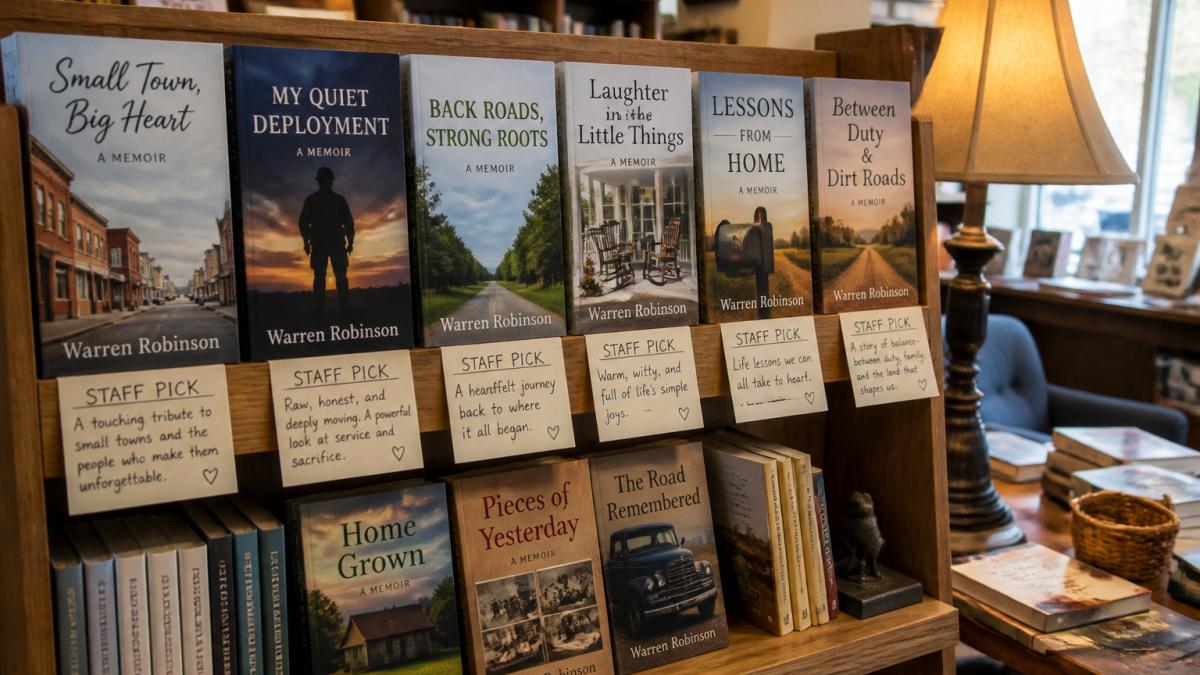
The Difference Between a Bestseller and a Neighbor's Story
A bestseller is built for a national audience. Editors shape it, marketing teams position it, and the final product is polished for mass appeal. That polish has value. It also sands off the rough edges that make a story feel true.
A neighbor's memoir keeps those edges. The writer may describe a factory closing that your own family lived through. They may name a diner that no longer exists. That specificity is the whole point.
The Benefits of Reading Memoirs: Empathy, Perspective, and Self-Reflection
Reading memoirs builds empathy in a way that fiction often cannot. A firsthand account forces you to sit with another person's choices, regrets, and small victories without the escape hatch of knowing it is invented.
That effect gets sharper when the writer lives nearby. When the setting is a street you have driven down, the empathy is not abstract. You are comparing your own assumptions about a place against someone who actually lived there, and the gap between the two is where the learning happens.
The benefits of reading memoirs show up in three places:
- Empathy: You practice seeing events through a specific person's eyes, not a narrator's summary. With a local memoir, you also practice seeing your own community through eyes that are not yours.
- Perspective: You compare your own assumptions against someone who lived through the same era differently. A neighbor's account of a plant closure, a school integration, or a flood can contradict the version that got repeated at family dinners.
- Self-reflection: You notice which passages sting, and those reactions usually point at something unfinished in your own life.
Many readers find that a memoir about a hard season, whether war, illness, or loss, helps them process their own. That is not therapy, and no book replaces professional care. But stories do offer company.
Why Local Memoirs Add a Fourth Benefit
National memoirs teach you about a life. Local memoirs teach you about a life and a place you thought you already knew. That combination produces a benefit the standard list misses: corrected memory.
A common pattern among readers of regional memoirs is the moment of surprise, the author remembers a store, a teacher, or a neighborhood boundary differently than the reader does. That friction is useful. It shows how much of what we call "local history" is actually one family's version of events, repeated until it sounds like fact.
Local memoirs also surface voices that mainstream publishing rarely reaches. A retired nurse, a factory worker, a first-generation shop owner, or a longtime church volunteer may never land a national book deal, but their account of a place is often more detailed than anything a professional historian could assemble from archives. Reading them is one of the few ways to hear from people whose stories would otherwise stay inside a family.
Memoir vs Autobiography: What's the Real Difference?
The difference between memoir and autobiography comes down to scope. An autobiography covers an entire life from birth to the present. A memoir covers a slice of that life, chosen because it carries a theme.
That distinction matters when you shop. If you want a full chronology, look for an autobiography. If you want one event examined closely, look for a memoir.
| Feature | Memoir | Autobiography |
|---|---|---|
| Scope | One period or theme | Entire life |
| Structure | Thematic | Chronological |
| Voice | Reflective, personal | Factual, comprehensive |
| Typical length | Shorter | Longer |
| Best for | Understanding a moment | Understanding a life |
A personal narrative can borrow from both forms, which is why the labels blur in practice. Ask what the book is trying to do, not what category it claims.
Why the Distinction Matters More for Local Memoirs
When the author is a neighbor, the memoir-versus-autobiography question turns into a reliability question. A local memoir is often the only written record of a specific event, a mill closing, a flood, a school's last graduating class, so readers tend to treat it as history rather than as one person's recollection.
That is a mistake worth naming. Every memoir is a reconstruction, not a recording. Memory shifts over time, and writers choose which details to include. That does not make a memoir dishonest. It makes it a point of view, and a point of view is exactly what you want from a local author, as long as you read it as one.
Use these questions to judge what you are reading:
- Does the author acknowledge uncertainty? Phrases like "as I remember it" or "I may have the year wrong" signal honesty rather than weakness.
- Are dates and places consistent? Small errors are normal; a pattern of them is worth noting.
- Whose perspective is missing? A memoir of a labor dispute told only from management's side, or a neighborhood story told only by longtime homeowners, is incomplete by design.
- Does the book distinguish memory from documented fact? Good memoirs flag the difference, often by citing newspapers, courthouse records, or family letters.
- Can you corroborate the big claims? A county historical society, a library's local history room, or a digitized newspaper archive can confirm or complicate the central events.
Reliability in memoir means the writer is trustworthy about their own experience, not that every detail is provable. Read with that standard and you will get more from the book, and you will be better equipped to tell which local memoirs are worth passing on to the next reader.
Memoirs About Community History and Sense of Place
Memoirs about community history preserve details that official records skip. A town archive lists when a mill opened and closed. A memoir tells you what the night shift smelled like and who brought coffee to the line.
That is where sense of place comes from. Regional identity is not a slogan on a welcome sign. It is the accumulated memory of people who were there.
For readers in Georgia and similar communities, this function is practical. When a longtime resident dies, a library of unrecorded knowledge goes with them unless someone wrote it down. Local memoirs act as primary sources for the next generation of historians.
How to Find Local Authors and Their Memoirs
Finding local authors takes more effort than browsing a national bestseller list, but the payoff is a shelf nobody else has.
Start with these sources:
- Independent bookstores: Staff at independent shops often know regional writers personally and can point you to recent releases.
- Public libraries: Many libraries maintain a local authors collection and host readings.
- Historical societies: Regional historical groups frequently sell or recommend memoirs tied to the area.
- Local book festivals and author events: These gatherings put you in the same room as the writers.
- Publisher websites: Small presses that specialize in regional or military memoirs list their catalogs directly.
If you want to support local writers, buying directly from the author or a small press usually sends more of the money to the person who wrote the book. American Booksellers Association resources on independent bookstores offers directories and context on why independent shops matter to regional literature.
Warren Robinson Books publishes memoirs and humorous small-town stories from a local author, and buying directly from a small publisher is one of the simplest ways to keep regional writing alive.
Evaluating Memoirs for Accuracy, Perspective, and Reliability
Every memoir is a reconstruction, not a recording. Memory shifts over time, and writers choose which details to include. That does not make a memoir dishonest. It makes it a point of view.
Use these questions to judge what you are reading:
- Does the author acknowledge uncertainty? Phrases like "as I remember it" signal honesty.
- Are dates and places consistent? Small errors are normal; a pattern of them is worth noting.
- Whose perspective is missing? A war memoir told only from one side of the conflict is incomplete by design.
- Does the book distinguish memory from documented fact? Good memoirs flag the difference.
Reliability in memoir means the writer is trustworthy about their own experience, not that every detail is provable. Read with that standard and you will get more from the book.
Conclusion: Your Next Great Read Might Live Down the Street
The books that stay with you are often the ones written by someone who sat across a table from you at a community event. Local author memoirs offer that closeness, plus a record of places and people that larger publishers overlook.
If you are ready to start, Warren Robinson Books offers authentic military memoirs and lighthearted small-town tales, all written by local author Warren Robinson. Our catalog includes real war stories and personal reflections alongside humorous stories from small-town life, with quality narratives at a fair price. Add to Cart and see what your own community has been writing.
Frequently Asked Questions
Why would someone read a memoir instead of a history book?
A memoir gives you a firsthand account of events through one person's lived experience, which history books often flatten into dates and statistics. You get the emotional texture, the small details, and the subjective memory that make events feel real. For example, a Vietnam War memoir shows what a firefight smelled like and how a soldier felt writing a letter home. That personal narrative builds empathy in ways a textbook cannot.
How do I know if a local author's memoir is accurate?
No memoir is perfectly objective because memory itself is subjective. Look for signs of care: does the author acknowledge gaps in memory? Do they cite letters, journals, or interviews with others? Cross-check key events against local newspaper archives or historical society records. A trustworthy memoir does not pretend to be a court transcript. It tells you what the author remembers and how they felt about it.
What is the difference between a memoir and an autobiography?
An autobiography covers your entire life from birth to the present, often in chronological order. A memoir zooms in on a specific period, theme, or relationship. For instance, a memoir might focus only on the author's three years in the military or their childhood in a small town. Memoirs tend to be more reflective and emotional, while autobiographies aim for comprehensive coverage. Both are personal narratives, but the scope and depth differ.
How can I find memoirs by local authors in my area?
Start with independent bookstores, which often have a dedicated local authors shelf. Ask librarians at your public library, especially those who manage regional history collections. Check local historical societies and writers' guilds. Attend book festivals, author readings at coffee shops, or community college events. You can also search online for your state or city plus 'local author memoir' and browse results from small presses or self-published writers.