
Is Buying Direct Cheaper Than Amazon? 2026 Guide
Table of Contents
- The Real Cost of Buying Direct vs. Amazon
- How to Compare Book Prices Including Shipping
- Amazon Book Prices vs Publisher Prices: What the Data Shows
- Marketplace Fees and Seller Profit: Who Pays for the Convenience?
- Why Buy Books Directly from the Author?
- Support Authors by Buying Direct: The Small Business Impact
- A Practical Decision Framework by Product Category
- Conclusion: When Buying Direct Wins and When Amazon Wins
- Frequently Asked Questions
Last Updated: October 4, 2026
The Real Cost of Buying Direct vs. Amazon
Is buying direct cheaper? For most books, no on sticker price alone, but buying direct cheaper overall is what you get once you factor in what you actually receive. At Warren Robinson Books, we sell directly because it keeps more of each sale in the author's hands and lets us answer reader questions ourselves.
The gap between the two channels starts with how each one is built.
Why the Sticker Price Is Only Half the Story
The listed price is a starting point, not the final number. Shipping, sales tax, membership benefits, and coupon codes all move the total, and they move differently depending on where you check out.
A common mistake is comparing a marketplace price to a brand website price without matching edition, format, and shipping speed. The same paperback can look like two different products once you line up the details.
How to Compare Book Prices Including Shipping
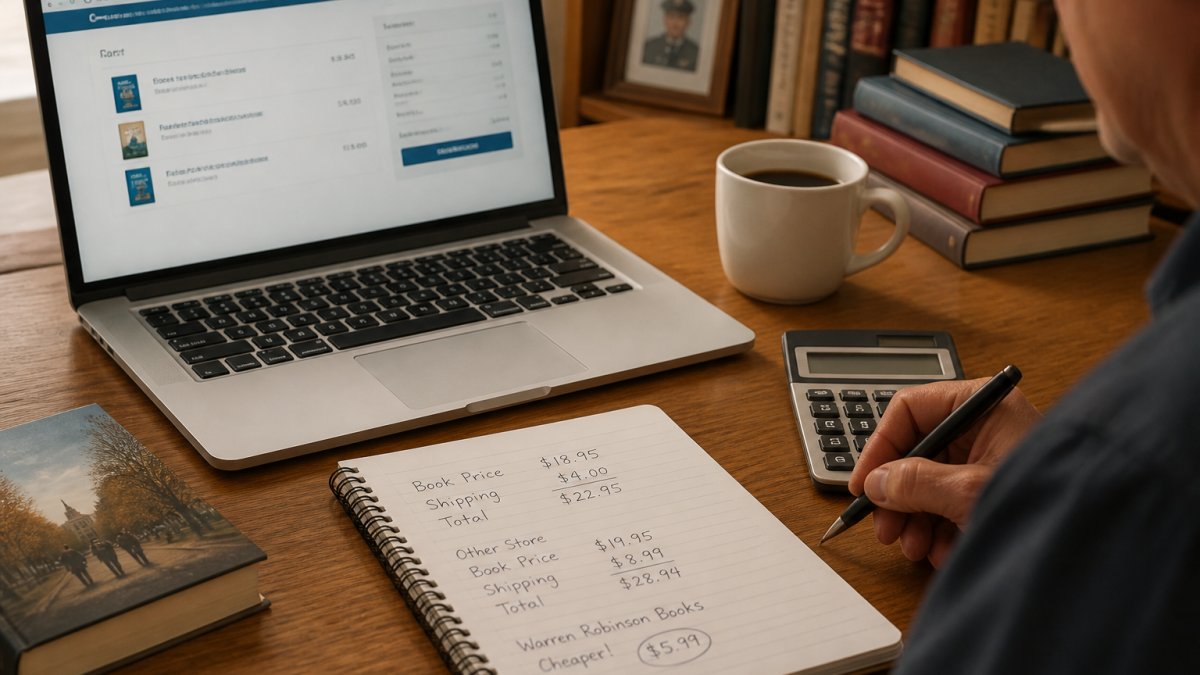
To compare book prices including shipping accurately, build the checkout total the way the checkout page builds it, not the way search results show it: add item price, shipping, and sales tax, subtract every discount you can actually claim, then add back the cost of a return if the order goes wrong.
Most guides stop at "add shipping and tax," but the two channels apply tax and shipping at different points and treat returns differently.
The Total Cost Formula, With the Parts People Skip
Use this expanded formula for every option you are weighing:
Total Cost = Item Price + Shipping + Sales Tax + Return Cost (if any) − Discounts − Membership Credits
A few mechanics worth knowing before you plug in numbers:
- Sales tax. In the U.S., states with sales tax generally require online sellers to collect it once the seller crosses that state's economic nexus threshold, which most large marketplaces and many direct stores have crossed. A direct store that hasn't crossed it in your state may not collect tax at all, quietly making it cheaper. Check the order summary, not the product page.
- Shipping. A marketplace listing's shipping is set by the individual seller, so two listings for the same book can ship at different speeds and prices. A direct store usually has one policy for the whole catalog.
- Membership credits. Subscription programs bundling free or faster shipping only lower your effective cost if you were already paying for other reasons. If you signed up just for this order, divide the annual fee by your expected number of orders and add it back in.
A Worked Like-for-Like Example
Here is the method, using placeholder prices so you can see the shape of the math. Substitute your own numbers.
| Line item | Marketplace listing | Direct from the seller |
|---|---|---|
| Item price | $18.99 | $21.99 |
| Shipping | $3.99 (seller-set) | $0 over a $25 threshold, otherwise $4.50 |
| Sales tax | Collected at checkout | Collected at checkout |
| Discount applied | None available | 10% first-order code |
| Effective total before tax | $22.98 | $19.79 |
| Return window | 30 days, buyer pays return shipping | 30 days, seller pays return shipping |
| Cost if returned | $3.99-$7.00 out of pocket | $0 out of pocket |
The headline price was lower on the marketplace. The effective total was lower direct, and the downside if the order went wrong was smaller direct too. That is the pattern the sticker price hides.
Why a Like-for-Like Comparison Is Rare
Almost no buying guide publishes a dated, reproducible comparison of the same item across both channels, because prices change weekly. That is why you should run your own, and why the formula matters more than any single example.
The Total Cost Formula: Price + Shipping + Tax - Discounts
Use this formula for every option:
Total Cost = Item Price + Shipping Cost + Sales Tax - Discounts
Run it in a simple table so the comparison stays honest:
| Cost Factor | Marketplace Listing | Direct from Author |
|---|---|---|
| Item price | Often discounted | Set by the author |
| Shipping cost | Varies by seller and speed | Varies by store policy |
| Sales tax | Applied at checkout | Applied at checkout |
| Discounts | Coupon codes, membership perks | Direct-site promotions, bundles |
| Support contact | Marketplace help center | The author or publisher |
| Return window | Marketplace policy | Store policy |
The cheapest sticker price does not always win: a slightly higher direct price with free shipping and a longer return window can come out ahead.
Amazon Book Prices vs Publisher Prices: What the Data Shows
Amazon book prices vs publisher prices rarely match, and the reason is structural: marketplaces can discount aggressively because the seller, not the platform, absorbs the full cost.
When a third-party seller lists a book, marketplace fees come off the top before the seller sees a cent, so the seller either raises the price to protect margin or accepts a thinner one.
A low marketplace price can also signal a seller cutting corners on packaging, shipping speed, or service to stay profitable.
Marketplace Fees and Seller Profit: Who Pays for the Convenience?
Marketplace fees and seller profit are directly linked, and the buyer usually pays for the convenience. A marketplace typically charges a referral fee (a percentage of the sale price), a variable closing fee on certain categories, and a payment-processing fee, plus per-unit pick-and-pack, weight-based shipping, and monthly storage if the seller uses its fulfillment network.
That structure produces predictable behaviors, and once you know them you can read a listing the way a seller does.
The Break-Even Math a Seller Runs
A seller pricing a book must cover four things before profit: the book's cost, the marketplace's cut, shipping, and returns and customer-service time. If the marketplace's cut plus shipping exceeds the built-in margin, the seller has three options:
- Raise the price to protect margin, which shrinks or erases the apparent discount.
- Cut costs elsewhere, slower shipping, lighter packaging, fewer support hours, which shifts the cost to the buyer in the form of wait time and risk.
- Exit the platform or stop listing that title, which reduces selection.
None of those three outcomes is a discount for you. They are the same cost, moved to a different line.
Why the Same Book Has Two Different Prices on the Same Platform
Two sellers listing the identical title at different prices is not a glitch. It usually means one acquired stock cheaper (remaindered copies, a bulk buy, a returns pallet) or is running a thinner margin to win the sale. A dramatically lower price is a signal worth reading, not a deal to grab blindly.
What This Means for the Buyer
For a reader, the practical takeaway is that the marketplace price is not automatically lower, it is lower for the platform, and the seller and often the buyer absorb the difference. Comparing a marketplace listing to a direct purchase means comparing two different bundles of price, speed, packaging, and recourse. The fee structure is why.
Why Buy Books Directly from the Author?
Buying direct means your money reaches the person who wrote the book, and you get a real point of contact if something goes wrong. For many readers, that is worth a small price difference.
Authenticity, Authorized Sellers, and Warranty Risks
Product authenticity matters more than most buyers realize.
Buying from an authorized seller, the author's own store or a verified retailer, removes that risk. You know the edition, the condition, and who to contact if the order is wrong.
Warranty and returns work the same way. A direct purchase comes with the author's or publisher's own return policy, usually simpler than a marketplace dispute process.
Support Authors by Buying Direct: The Small Business Impact
When you support authors by buying direct, a larger share of your money reaches the person who did the work, especially important for independent and local authors on thin margins.
For a small publisher like Warren Robinson Books, a direct sale means we can keep producing the personal, reflective work large catalogs rarely prioritize.
Ethical shopping is not about guilt; it is about where the money lands. A direct purchase keeps more with the creator and less with the middle layer.
A Practical Decision Framework by Product Category
The right channel depends on what you are buying and why. Use this framework to decide quickly.
| Product Type | Buy Direct When | Buy from a Marketplace When |
|---|---|---|
| Signed or limited editions | Always, only the author can guarantee it | Rarely available |
| Standard paperbacks | You want author support and a clear return policy | You need the lowest possible sticker price |
| Digital formats | The author's store offers the format you need | The marketplace has your preferred e-reader locked in |
| Gifts and bundles | You want a specific edition or inscription | You are buying many unrelated items at once |
| Out-of-print titles | The author still holds stock | A third-party seller is the only source left |
Price matching and direct-site incentives tip the scale further: many authors run promotions, bundle deals, or free shipping thresholds a marketplace listing cannot match, especially once you factor in support and authenticity.
Conclusion: When Buying Direct Wins and When Amazon Wins
The honest answer to whether buying direct is cheaper than Amazon depends on what you count. If you only count sticker price, a marketplace often wins.
The choice between buying direct and buying through a marketplace comes down to what you value most. If you want the lowest number on a screen, a marketplace usually delivers it. If you want authentic stories, a clear return policy, and your money reaching the author, explore our collection.
Frequently Asked Questions
Is it cheaper to buy books directly from the publisher or on Amazon?
It depends on the book and the publisher's current promotions. Amazon often discounts books below list price, but buying direct can be cheaper when the publisher offers coupon codes, free shipping thresholds, or bundled deals. You also avoid sales tax in some cases. To know for sure, compare the total cost including shipping and tax before checkout. For signed or specialty editions, direct is often the only option and may cost less than third-party resellers.
Does buying direct usually include free shipping?
Many independent authors and small publishers offer free shipping on orders over a certain amount, often $25 to $35. Amazon offers free shipping on orders over $25 for non-Prime members, or free two-day shipping with Prime. If you are buying a single book, direct shipping might add $4 to $6, while Amazon may already include it. Check the brand website for current free shipping thresholds and membership benefits before you compare prices.
How do you compare the total cost of buying direct and buying on Amazon?
Use a simple formula: retail price + shipping cost + sales tax - any discount or coupon code. Amazon's price may look lower, but third-party seller shipping can add $3.99 or more. Direct purchases sometimes include free shipping and a discount code for first-time buyers. Also factor in delivery speed and returns. A $2 difference may not matter if one option arrives in two days and the other takes two weeks.
Are books cheaper on Amazon or from an independent author?
Independent authors often set a retail price close to Amazon's because Amazon takes a marketplace fee, usually 40% or more on print books. When you buy direct, the author keeps a larger share, so they can sometimes offer a lower price or free shipping. However, Amazon may discount bestsellers below cost to drive traffic. For mid-list or specialty titles, direct is often the same price or cheaper, and you get better customer service.